Showing posts with label architecture. Show all posts

Tuesday, 21 March 2017

Donne Martin/system-design-primer: Learn how to design large-scale systems. Prep for the system design interview.

GitHub - donnemartin/system-design-primer: Learn how to design large-scale systems. Prep for the system design interview.: "Motivation

Learn how to design large scale systems.

Prep for the system design interview.
Learn how to design large scale systems

 Learning how to design scalable systems will help you become a better engineer.

System design is a broad topic.

There is a vast amount of resources scattered throughout the web on system design principles.

This repo is an organized collection of resources to help you learn how to build systems at scale."


'via Blog this'

Saturday, 28 January 2017

4 essential skills software architects need to have but often don’t - O'Reilly Media

4 essential skills software architects need to have but often don’t - O'Reilly Media: "Microservices. Continuous delivery. Reactive systems. Cloud native architecture. Many software architects (or even aspiring ones) have at least a passing familiarity with the latest trends and developments shaping their industry. There are plenty of resources available for learning these topics, everything from books and online videos to conference presentations; the ability to go from novice to expert in these areas is right at their fingertips. However, as today’s trends quickly bleed into tomorrow’s standards for development, it’s paramount that software architects become change agents within their organizations by putting into practice the “unspoken” side of their skill set: communication and people skills"


'via Blog this'

Wednesday, 21 December 2016

infoQ: Architecture: Technologies for the Future of Software Engineering

Technologies for the Future of Software Engineering: "The Cloud, infrastructure as code, federated architectures with APIs and anti-fragile systems: these are technologies for developing software systems that are rapidly coming into focus, claimed Mary Poppendieck. She spoke about the future of software engineering at GOTO Berlin 2016.

If you have too much data to fit on one computer, you have two options: scale up or scale out. Scaling up by using a bigger computer is usually not the right direction to take, argued Poppendieck. You need to scale out by getting more computers and build systems of computers.

Poppendieck mentioned different ways to scale out:

Scale out files: an example is the approach that Google uses for searching. Files are split up into small pieces which are copied to multiple servers. Then the searching is done in parallel, and the results from all servers are combined into one search result.
Scale out architecture: Amazon does this by breaking transactions into services and using specific servers to do the services. If there’s a bottleneck, then you can replicate the service on multiple servers. Each service is owned by a semi-autonomous "two pizza" team.
Systems are moving more and more towards the cloud; there is a cloud in your future, said Poppendieck"

Having one central database creates a dependency problem as all applications depend on the database, and changing the database can impact many applications. Poppendieck stated that "the enterprise database is a massive dependency generator". Individual teams cannot deploy autonomously as their work has to be coordinated with all other teams sharing the database. Instead of having one database, you need a federated architecture where you split into local data stores appropriate to the needs of individual modules or services, and accessed only through APIs. APIs are replacing central shared databases and they enable the internet of things. You have to learn to do software engineering with APIs, argued Poppendieck. Look at APIs as products which are owned by a responsible team, and focus on the API customers to evolve and develop new capabilities.
We need to stop trying to make systems failure free and start thinking differently, said Poppendieck. Many of our current systems are fragile; they started as robust systems but over time they have become difficult to maintain. Systems nowadays need to be anti-fragile, and able to embrace failure, claimed Poppendieck. When things go wrong, systems should be capable of limiting damage and recovering from failures.
You get anti-fragile systems from the way you test systems, which is by failure injection to make something go wrong. Poppendieck mentioned that your systems need to isolate and automatically recover from failure, in order to achieve today’s expected levels of availability and robustness.
Poppendieck mentioned aspects that are essential nowadays for developing software. She said that you need a deployment pipeline to be able to do continuous delivery, and you need cross-functional teams including product management, testers, and operations to get the benefits promised by continuous delivery. The deployment pipeline depends on automated processes for testing, migration, and deployment. Continuous delivery requires all teams to communicate through the codebase by doing continuous integration to the trunk. Teams keep the software always production-ready; if that’s not the case you have to stop and make it so. While deployment is continuous, release is incremental by toggle or switch whenever a useful increment or capability is ready.

'via Blog this'

Wednesday, 3 August 2016

Simple Sketches for Diagramming Your Software Architecture | Voxxed

Simple Sketches for Diagramming Your Software Architecture | Voxxed: "If you’re working in an agile software development team at the moment, take a look around at your environment. Whether it’s physical or virtual, there’s likely to be a story wall or Kanban board visualising the work yet to be started, in progress and done. Visualising your software development process is a fantastic way to introduce transparency because anybody can see, at a glance, a high-level snapshot of the current progress.


 As an industry, we’ve become adept at visualising our software development process over the past few years – however, it seems we’ve forgotten how to visualise the actual software that we’re building. I’m not just referring to post-project documentation. This also includes communication during the software development process. Agile approaches talk about moving fast, and this requires good communication, but it’s surprising that many teams struggle to effectively communicate the design of their software."


'via Blog this'

Friday, 17 June 2016

Serverless Architectures

Serverless Architectures: "Like many trends in software there’s no one clear view of what ‘Serverless’ is, and that isn't helped by it really coming to mean two different but overlapping areas:


  1.  Serverless was first used to describe applications that significantly or fully depend on 3rd party applications / services (‘in the cloud’) to manage server-side logic and state. These are typically ‘rich client’ applications (think single page web apps, or mobile apps) that use the vast ecosystem of cloud accessible databases (like Parse, Firebase), authentication services (Auth0, AWS Cognito), etc. These types of services have been previously described as ‘(Mobile) Backend as a Service’, and I’ll be using ‘BaaS’ as a shorthand in the rest of this article. 
  2. Serverless can also mean applications where some amount of server-side logic is still written by the application developer but unlike traditional architectures is run in stateless compute containers that are event-triggered, ephemeral (may only last for one invocation), and fully managed by a 3rd party. (Thanks to ThoughtWorks for their definition in their most recent Tech Radar.) One way to think of this is ‘Functions as a service / FaaS’ . AWS Lambda is one of the most popular implementations of FaaS at present, but there are others. I’ll be using ‘FaaS’ as a shorthand for this meaning of Serverless throughout the rest of this article."


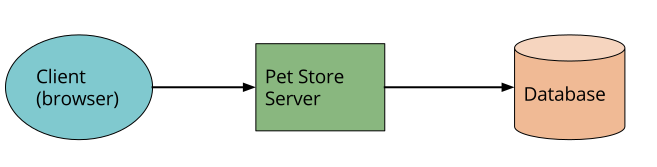
Let’s think about a traditional 3-tier client-oriented system with server-side logic. A good example is a typical ecommerce app (dare I say an online pet store?)
Traditionally the architecture will look something like this, and let’s say it’s implemented in Java on the server side, with a HTML / Javascript component as the client:

Figure 1
Figure 1
With this architecture the client can be relatively unintelligent, with much of the logic in the system - authentication, page navigation, searching, transactions - implemented by the server application.
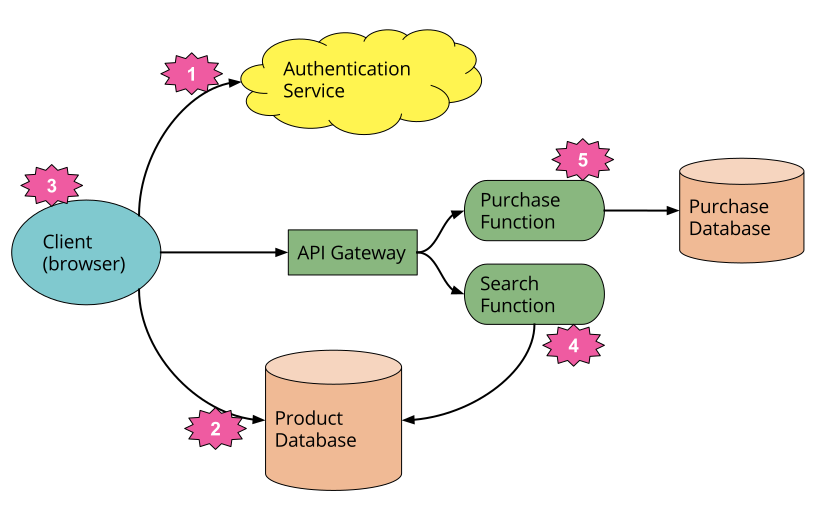
With a Serverless architecture this may end up looking more like this:

Figure 2
Figure 2


'via Blog this'

Tuesday, 7 June 2016

Yet Another Distributed Systems Reading List

"Yet Another Distributed Systems Reading List 

I started putting together a reading list for engineers fairly new to distributed systems and theory, with little hands-on experience yet."


'via Blog this'

Friday, 27 May 2016

Heroku Metrics: There and Back Again

Heroku Metrics: There and Back Again: "No system is perfect, and ours isn’t some magical exception. We’ve learned some things in this exercise that we think are worth pointing out.

Sharding and Partitioning Strategies Matter 

Our strategy of using the owner column for our shard/partitioning key was a bit unfortunate, and now hard to change. While we don’t currently see any ill effects from this, there are hypothetical situations in which this could pose a problem. For now, we have dashboards and metrics which we watch to ensure that this doesn’t happen and a lot of confidence that the systems we’ve built upon will actually handle it in stride.
Even still, a better strategy, likely, would have been to shard on owner + process_type (e.g. web), which would have spread the load more evenly across the system. In addition to the more even distribution of data, from a product perspective it would mean that in a partial outage, some of an application’s metrics would remain available.

Extensibility Comes Easily with Kafka 

The performance of our Postgres cluster doesn’t worry us. As mentioned, it’s acceptable for now, but our architecture makes it trivial to swap out, or simply add another data store to increase query throughput when it becomes necessary. We can do this by spinning up another Heroku app that uses shareable addons, starts consuming the summary topics and writes them to a new data store, with no impact to the Postgres store!
Our system is more powerful and more extensible because of Kafka."


'via Blog this'

Sunday, 22 May 2016

The InfoQ Podcast: Uber's Chief Systems Architect = No Node.js, no JSON over HTTP

The InfoQ Podcast: Uber's Chief Systems Architect on their Architecture and Rapid Growth: "In this week's podcast QCon chair Wesley Reisz talks to Matt Ranney who is the Chief Systems Architect at Uber, where he's helping build and scale everything he can. Previously, Matt was a founder and CTO of Voxer, probably the largest and busiest deployment of Node.js.

Key takeaways

Expanding a company and team at this rate is genuinely hard. Lots of mistakes have been made along the way.
Microservices allow companies to grow rapidly but have a cost in terms of aggregate velocity.
Uber is gradually moving its marketplace development from Node.js to Go and Java. Java is used for the map services.
Aggressive failure testing is used extensively in Uber.
Some early design choices - like using JSON over HTTP - make formal verification basically impossible."


'via Blog this'

Wednesday, 18 May 2016

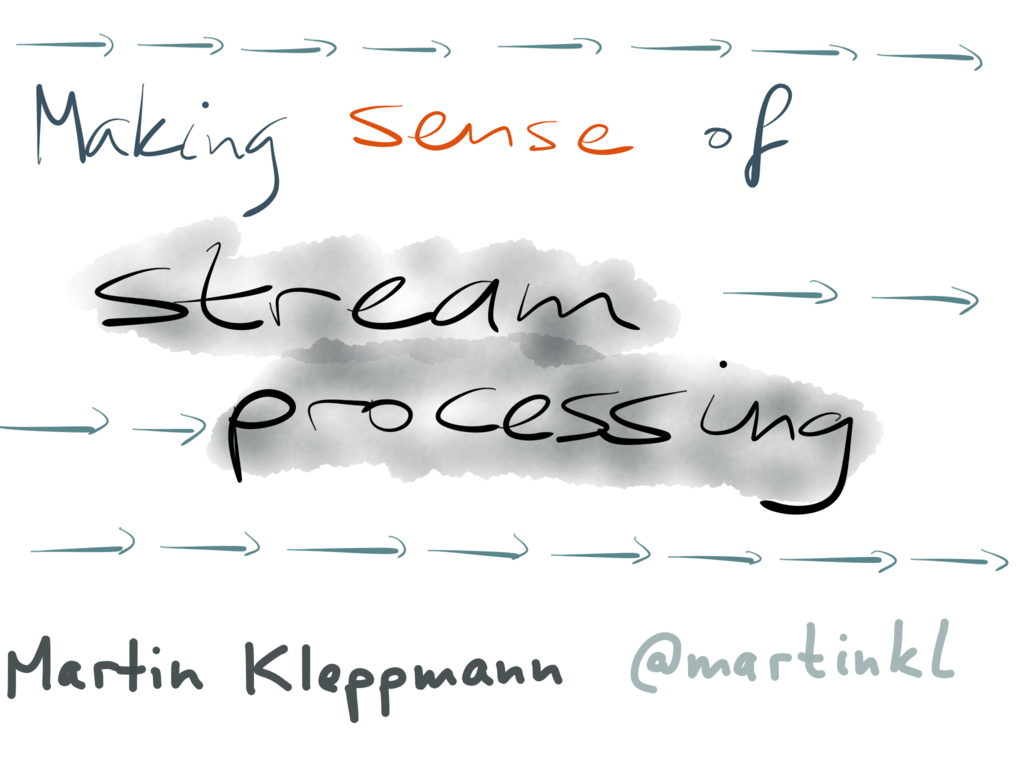
Stream processing, Event sourcing, Reactive, CEP… and making sense of it all — Martin Kleppmann’s blog

Stream processing, Event sourcing, Reactive, CEP… and making sense of it all — Martin Kleppmann’s blog: "Some people call it stream processing. Others call it Event Sourcing or CQRS. Some even call it Complex Event Processing. Sometimes, such self-important buzzwords are just smoke and mirrors, invented by companies who want to sell you stuff. But sometimes, they contain a kernel of wisdom which can really help us design better systems.

In this talk, we will go in search of the wisdom behind the buzzwords. We will discuss how event streams can help make your application more scalable, more reliable and more maintainable. Founded in the experience of building large-scale data systems at LinkedIn, and implemented in open source projects like Apache Kafka and Apache Samza, stream processing is finally coming of age."


Title: making sense of stream processing


'via Blog this'

Serverless and Event Architectures — Medium

Serverless and Event Architectures — Medium: "I’m just starting to think these ideas out and implement these ideas into our systems. I know that there are existing architectures out there (SOA, EDA, BBQ… no… not the last one… I must be hungry) that deal with loosely coupled and distributed systems. IoT is also a space where this kind of an idea is a given too. However, I do think that Serverless is an iteration beyond the autoscaling PaaS and container based solutions and frameworks because none of those previous systems envisaged such a fragmented and loosely coupled codebase as well.
So maybe the core elements of Serverless are: 


Loosely coupled managed services combined with stateless loosely coupled micro-functions 


There will be issues
I’m sure. There are problems with the implementation of this, but it’s definitely something I’m going to try to figure out as I go forwards.
AWS Lambda isn’t everything, but combining it with all the other AWS services such as Cognito, API Gateway, SNS, SQS, S3… it does seem to have a lot of these ideas already there to experiment and try out new solutions.
Maybe the other providers need to focus less on the micro-compute side and more on the loosely coupled services. It’s not all about VMs and autoscaling any more.
Serverless is about flows and streams of data and events and messages.
This is the future (imho)"


'via Blog this'

Friday, 6 May 2016

Microservice Threading Models and Their Tradeoffs

Microservice Threading Models and Their Tradeoffs: "Architects designing Micro-Service Architectures typically focus on patterns, topology, and granularity, but one of the most fundamental decisions to make is the choice of threading model. With the proliferation of so many viable open source tools, programming languages, and technology stacks, software architects have more choices to make now than ever before.

It is very easy to get lost in the details of nuanced language and/or library differences and lose sight of what is important.

Choosing the right threading model for your micro-services and how it relates to database connectivity can mean the difference between a solution that’s good enough and a product that’s amazing."


'via Blog this'

Tuesday, 3 May 2016

Voxxed: Microservices Versus SOA in Practice


Microservices Versus SOA in Practice
So microservices and SOA have a lot in common. They are both systems that typically contain sets of loosely coupled distributed components. However, the intention behind the two architectures is very different: SOA is trying to integrate applications and typically uses a central governance model to ensure that applications can interoperate. Microservices is trying to deploy new features and scale development organizations quickly and efficiently. It focuses on decentralization of governance, code reuse, and automation to do this.
To summarize:

Friday, 8 April 2016

Simple Sketches for Diagramming Your Software Architecture | Voxxed

Simple Sketches for Diagramming Your Software Architecture | Voxxed: "Informal boxes and lines sketches can work very well, but there are many pitfalls associated with communicating software designs in this way. My approach is to use a small collection of simple diagrams that each show a different part of the same overall story. In order to do this though, you need to agree on a simple way to think about the software system that you’re building.

Assuming an object oriented programming language, the way that I like to think about a software system is as follows: a software system is made up of a number of containers, which themselves are made up of a number of components, which in turn are implemented by one or more classes. It’s a simple hierarchy of logical technical building blocks that can be used to illustrate the static structure of most of the software systems I’ve ever encountered. With this set of abstractions in mind, you can then draw diagrams at each level in turn. I call this my C4 model: context, containers, components and classes. Some diagrams will help to explain this further."


'via Blog this'

Saturday, 19 March 2016

Container Tidbits: When Should I Break My Application into Multiple Containers? – Red Hat Enterprise Linux Blog

Container Tidbits: When Should I Break My Application into Multiple Containers? – Red Hat Enterprise Linux Blog:


There is a lot of confusion around which pieces of your application you should break into multiple containers and why. I recently responded to this thread on the Docker user mailing list which led me to writing today’s post. In this post I plan to examine an imaginary Java application that historically ran on a single Tomcat server and to explain why I would break it apart into separate containers. In an attempt to make things interesting – I will also aim to justify this action (i.e. breaking the application into separate containers) with data and (engineering) logic… as opposed to simply stating that “there is a principle” and that one must adhere to it all of the time.

Let’s take an example Java application made up of the following two components:
  1. A front-end application built on the Struts Web Framework
  2. A back-end REST API server built on Java EE

As mentioned, this application historically ran in a single Tomcat server and the two components were communicating over a REST-based API… so the question becomes:

Should I break this application into multiple containers?
Yes. I believe this application should be decomposed into two different Docker containers… but only after careful consideration.

Thursday, 25 February 2016

Big Changes in Goldman’s Software Emerge From Small Containers - The CIO Report - WSJ

Big Changes in Goldman’s Software Emerge From Small Containers - The CIO Report - WSJ:

“I have lived through all sorts of tech transitions, and this is faster than anything we have seen,” Docker CEO Ben Golub said. Docker usage increased five times during the past year, and Docker images have been downloaded more than two billion times. Docker said it is the second-largest open-source infrastructure project.
“Think of docker as two things: a format for packaging apps and an engine to run those apps,” Forrester Research analyst Dave Bartoletti said in an email. “Docker is quickly becoming the de facto standard for packaging. You can RUN dockerized apps on lots of different engines. And then when you run them, you can pick from a wide range of orchestration tools, management tools, monitoring tools, etc.”
There was concern that Docker, the company, had too much power, as both the custodian of the open-source software and a venture that sold products and services tied to it, according to Mr. Duet. In response, Docker, the company, helped form the Open Container Initiative to govern the open-source software.
Goldman uses the Docker containerization service, as well as container orchestration tools from Docker and Alphabet Inc GOOGL +0.50%.’s Google, which makes an orchestration and cluster management tool called Kubernetes, comparable to Docker Swarm. “We do both, Docker and Kubernetes, for things like running and starting,” Mr. Duet said. “Kubernetes is arguably a better scheduler…if you are going to run 1,000 containers on 1,500 computers…It is designed much more for that. Docker’s own product is great if you want to run five containers on three machines. We have both problems.”
A Docker spokesman said that “even when people use Kubernetes, they are still using the Docker container service. Some, such as Goldman, continue to use Kubernetes for larger deployments and Docker Swarm for smaller, as Docker Swarm was only made generally available in Fall of 2015 and is still being evaluated for large-scale use.”
For Goldman, the shift is part of a larger evolution, as the bank takes on more of the characteristics of a tech company. Says Mr. Duet: “We look more like Google and Amazon in many ways.”


Monday, 11 January 2016

Microservices links


The Power, Patterns, and Pains of Microservices

A full-throated advocate of winning knows that the one constant in business is change. The winners in today's ecosystem learned this early and quickly.
One such example is Amazon. They realized early on that they were spending entirely too much time specifying and clarifying servers and infrastructure with operations instead of deploying working software. They collapsed the divide and created what we now know as Amazon Web Services (AWS). AWS provides a set of well-known primitives, a cloud , that any developer can use to deploy software faster. Indeed, the crux of the DevOps movement is about breaking down the invisible wall between what we knew as developers and operations to remove the cost of this back-and-forth.
Another company that realized this is Netflix. They realized that while their developers were using TDD and agile methodologies, work spent far too long in queue, flowing from isolated workstations—product management, UX, developers, QA, various admins, etc.—until finally it was deployed into production. While each workstation may have processed its work efficiently, the clock time associated with all the queueing meant that it could sometimes be weeks (or, gulp , more!) to get software into production.
In 2009, Netflix moved to what they described as the cloud-native architecture . They decomposed their applications and teams in terms of features; small (small enough to be fed with two pizza-boxes !) collocated teams of product managers, UX, developers, administrators, etc., tasked with delivering one feature or one independently useful product. Because each team delivered a set of free-standing services and applications, individual teams could iterate and deliver as their use cases and business drivers required, independently of each other. What were in-process method invocations became independently deployed network services.
Microservices, done correctly, hack Conway's law and refactor organizations to optimize for the continuous and safe delivery of small, independently useful software to customers. Independently deployed software can be more readily scaled at runtime. Independently deployed software formalizes service boundaries and domain models; domain models are forced to be internally consistent, something Dr. Eric Evans refers to as a bounded context in his epic tome, Domain Driven Design .
Independent deployability implies agility but also implies complexity; as soon as network hops are involved you have a distributed systems problem!

Tuesday, 5 January 2016

Vert.x links


ECMAScript 6/7 on the JVM with TypeScript and Vert.x

Following the latest releases of Vert.x 3.2 and vertx-lang-typescript 1.1.0 I figured it would be a good idea to give you a couple of examples how teaming Vert.x and TypeScript helps you use ECMAScript 6 and 7 features on the JVM today.
The vertx-lang-typescript library adds TypeScript support to Vert.x 3. TypeScript is a typed superset of JavaScript that compiles to plain JavaScript. It supports the ECMAScript 6 (ECMAScript 2015, ES6) standard and also a few parts of ECMAScript 7 (ES7) already.
The library automatically compiles Vert.x verticles written in TypeScript to JavaScript and executes them on the JVM. vertx-lang-typescript also provides type definitions for the Vert.x JavaScript API. Use them in your favourite TypeScript editor/IDE to get auto-completion, API documentation and meaningful error messages.


Vert.x is a reactive, microservices toolkit for the JVM, that provides an asynchronous, scalable, concurrent services development model. It supports polyglot language development with first class support for JavaScript, Ruby, Groovy, Scala, and of course Java.
InfoQ got a chance to catch up with Tim Fox, the creators of Vert.x and the Vert.x lead architect to get his thoughts on Vert.x in general and the upcoming Vert.x 3 release.
Tim explains how Vert.x compares to Java EE, Spring, Akka, and explains how Vert.x is a good fit for microservices, reactive development.

InfoQ: What is Vert.x and why would someone pick it instead of a traditional Java stacks like Servlets or Java EE or Spring?Tim: Vert.x is a toolkit for writing polyglot reactive applications on the JVM. Unlike the traditional stacks its been designed from day one with microservices in mind, and it's also been designed with scalability in mind so it's almost completely non blocking (OS threads).
This is critical for many modern applications that need to handle a lot of concurrency - e.g. process a lot of messages or events, or handle a lot of connections.
Also, unlike the traditional Java stacks, Vert.x supports other languages than Java - e.g. JS, Ruby and Groovy so we don't force you to always use Java and can use the best language for the job at hand or for the skill-set of your team.
Another important point is that Vert.x is toolkit, not a container or "framework". That means you can use it within your existing application to give it the Vert.x super powers. For example you can use it within your Spring application, and many users do.


Thursday, 24 December 2015

Choose Boring Technology - Discourage "Cleverness"

Dan McKinley: Choose Boring Technology (Link to Slides)

Embrace Boredom.

Let's say every company gets about three innovation tokens. You can spend these however you want, but the supply is fixed for a long while. You might get a few more after you achieve a certain level of stability and maturity, but the general tendency is to overestimate the contents of your wallet. Clearly this model is approximate, but I think it helps.
If you choose to write your website in NodeJS, you just spent one of your innovation tokens. If you choose to use MongoDB, you just spent one of your innovation tokens. If you choose to use service discovery tech that's existed for a year or less, you just spent one of your innovation tokens. If you choose to write your own database, oh god, you're in trouble.
Any of those choices might be sensible if you're a javascript consultancy, or a database company. But you're probably not. You're probably working for a company that is at least ostensibly rethinking global commerce or reinventing payments on the web or pursuing some other suitably epic mission. In that context, devoting any of your limited attention to innovating ssh is an excellent way to fail. Or at best, delay success [1].
What counts as boring? That's a little tricky. "Boring" should not be conflated with "bad." There is technology out there that is both boring and bad [2]. You should not use any of that. But there are many choices of technology that are boring and good, or at least good enough. MySQL is boring. Postgres is boring. PHP is boring. Python is boring. Memcached is boring. Squid is boring. Cron is boring.
The nice thing about boringness (so constrained) is that the capabilities of these things are well understood. But more importantly, their failure modes are well understood. Anyone who knows me well will understand that it's only with a overwhelming sense of malaise that I now invoke the spectre of Don Rumsfeld, but I must.


Why discouraging cleverness is important in programming languages and codebases.


One of the other benefits of Go was widening the pool of backgrounds we can hire. We can take someone from any language background and have them ramped up on Go in weeks. With the Scala side there’s the JVM learning curve, the Java world of containers, black magic of JVM tuning etc…
New developers we’ve hired are ramped up in weeks vs months. We now have the majority of our services written in Go and one of the last holdouts to move to Go just wrote his first project and said to me afterward “Wow, I read through that library once and I knew exactly what it was doing , I’ve read the Scala version of that library four times and I still have no idea what it does, I can see why you guys like it so much”. That was one of our senior engineers who’s previously worked for one of the largest web properties in the world. This process was a complete bottoms up initiative from our development team who pushed for the move to Go.
We now process hundreds of thousands of messages per second and Terabytes of data per day with our GoLang services.
I’m not here to bash Scala, or ScalaZ (I love ValidationNel! ) but more to give some real world context of Scala in a production environment over 7 years with two companies. I still use Scala and love hacking in Scalding. Some of our more ambitious projects coming up will most likely be Scala based but I’m just not as sold on it anymore as the core language when trying to scale a growing engineering team. Go has since become my personal language of choice.

Monday, 16 November 2015

Mark Little: Is Java EE Still Relevant?

https://developer.jboss.org/blogs/mark.little/2015/11/15/is-java-ee-still-relevant

I had a great time at JavaOne this year and Red Hat had a fantastic showing, with many sessions at the event, many more booth sessions (which were packed out as usual) and of course I made a brief appearance during the kickoff keynote. There had been a lot of interest in this event due to some recent events and rumours about what Oracle would or wouldn't say, specifically about the future of Java EE. This was even a topic of conversation during the JCP EC face-to-face meeting preceding JavaOne. But nothing much really happened and life, it seemed, would go on as usual. However, there was still a lot of discussion during several sessions and through the usual chatter on the floors or parties about the relevancy of Java EE these days.

But let's face it, this isn't a question that is only being asked in 2015; I've been involved in enterprise Java since before it was called J2EE and within a few years of bring created people were asking the same question. As I've mentioned many times over the past few years, people have asked the question when Web Services came along, then REST, PaaS/Cloud, mobile and now IoT. Each time the concept of middleware has evolved and Java EE, and its associated implementations, with it. People get hung up on the concept of Java EE and application servers as bloated, monolithic entities without actually looking at the reality of today's implementations (well, at least one). However, I'm not here to repeat what I've said time and time again(remember this from 2011?), most recently at HPTS 2015. Approaches such as WildFly Swarm and the massive interest it has seen, show that there's still a lot of interest. And I've already suggested how Java EE can fit into the next generation platforms.

Rather than revisit this question, which I think I've answered sufficiently, I wanted to link to Ian's entry on the JavaOne session he did, which I attended. It's always good to hear from someone else on the topic, though I'm sure some will argue he's not objective about this and neither am I. If you're still not convinced, think of the core capabilities within any Java EE application server, such as transactions, messaging, security, cacheing etc; services/capabilities that are needed way beyond Java and Java EE, pre-dating Java by decades and used together or independently in many applications. You can consider Java EE as a way of packaging these things together into a convenient bundle, where they are guaranteed to work well together or independently, and in most cases you probably don't even know they're there. Over the years, before Java was created and way beyond when it is just a mention in history books, that packaging will change but you'll still have something recognisable within middleware implementations, perhaps not co-locating services, perhaps not all implemented in the same language etc. And your future applications will probably not be able to tell the difference or know they're there ... again.

So whilst I think the original question is an important one to ask, I think a much better question is "Where should I use the core capabilities within Java EE?" And if you've got a suitably flexible and agile application server implementation, your application won't need to care that Java EE is, or is not, under the covers providing the desired dependability and reliability.


Of course microservices are the future. Ok, maybe there was a hint of sarcasm in that last sentences! Microservices have a role to play, just as SOA does (yes, I still believe the two are closely tied). There is some truth in there though: more streamlined, agile and dedicated services will be the basis of future application development, whether using (immutable) containers such as Docker or just the standard JVM, perhaps with fatjars. However, anyone who believes that the future of software (middleware) will appear instantaneously has obviously not looked back at other transitions, such as bespoke-to-CORBA or CORBA-to-J2EE. These things take time and evolution rather than revolution is the natural approach. Even if you've not been involved in middleware there are similar examples elsewhere in our industry: COBOL really is still in deployment today! Look at the interest we have around Blacktie!

Therefore, the future will evolve. Yes people will want to develop new applications (so called greenfield sites) using the latest and greatest framework or stack. But they'll also want to integrate with existing business logic and services written in a variety of present day technologies. So there'll still be Java EE application servers (e.g., EAP) with business logic within them, some of it legacy, some written from scratch today and into the future, despite what some may believe.

I believe that due to the fact Java EE has been the dominant non-Microsoft development and deployment platform for well over a decade, there are so many developers out there who are comfortable with it. Yes some may complain about the apparent bloat of implementations, but the reality is that it's still very easy to develop against and use from a variety of different programming languages. That's why the evolution towards any new paradigm is going to be heavily influenced by it, if not driven directly by those developers. So yes, I believe that microservices and Java EE go hand in hand for a large percentage of developers. Approaches such as WildFly-Swarm offer precisely what I'm describing: a comfortable entry point for developers and even existing applications, yet the power to move to a more flexible DevOps driven paradigm. WildFly, when used correctly, offers a mature and easy to use platform that has a minimal footprint and faster boot times than the most popular web servers around! And don't forget that Swarm builds on WildFly so we immediately get the maturity of implementations(s) from it.

However, this mad rush towards microservices, trimming of application servers, creation of applications from fatjars etc. needs to be approached with caution. Our industry is renowned for offering panaceas to problems that require throwing away all we've done before and relearning all of those hard earned lesson! We've got to break that cycle and in Red Hat we've got the pieces to do so: with so many open source projects out there purporting to be right for enterprise applications and new ones springing into life almost on a daily basis, it's easy to understand why people believe every new project is good enough for their requirements. Although I believe open source is a superior development methodology, it takes time and effort to build enterprise-ready components such as transaction servers, messaging brokers, etc. They don't just spring into life ready formed and fully capable. "Good enough" is rarely sufficient for enterprises. It's the edge cases like management, reliability, recoverability, scalability and bullet proof security that are hard to do and get right, yet it's precisely those edge cases that matter time and again. Through core development or acquisition, we've built up a stack that is mature and capable. Whether deployed as a stack or individual pieces, it's what we should be building the next generation of middleware solutions upon. A strong base exists today and we need to reuse as much of that as possible rather than rewrite from scratch in some new popular programming language.

Now as I hinted above, maybe we don't package our future stack or platform in quite the same way as we do today. Microservices offers an approach that is in line with the kinds of trimming we've been seeing anyway. Bundling individual components from the application server as easily deployed (container based) services that can then be exposed to other programming languages, frameworks, solutions etc. is definitely part of the overall solution space. Those core services, such as transactions or storage, could be deployed as individual services or, as is more typical with something like Swarm, deployed with the business logic that uses them. I keep coming back to the JBossEverywhere initiative we had a few years ago - ahead of its time!

Ok so we've looked to microservices and how Java EE fits in. But that can't be the entire answer - and it isn't. As I've mentioned before, at least for a very important set of applications and use cases the future is reactive and event driven. Now that could mean Node.js but just as likely in the Java world it probably means Vert.x. Note, given that many of the Java EE APIs aren't reactive or asynchronous in nature then we'll need to evolve them if we wish to tie them in to Vert.x and I do think we need to do that. Whilst some people will want to develop their applications and microservices in Vert.x from scratch, others will want to tie in legacy systems or have access to some of the core services I mention earlier. I see Vert.x as the ideal backbone or glue that brings all of these things together. The mature core services that we've got are precisely the sorts of things that enterprise developers will need for their applications as they grow in complexity - and let's face it, eventually many applications are going to need security, transactions, high performance messaging etc.

In the Java world the unit of containerisation is essentially the JVM. However, most Java developers realise that unless you ship a farjar, which contains everything you need to run your application/service, it's often typical to find that changes in third-party jars downloaded at deployment time can result in the application or service failing to run first time. This is where operating system containers, such as Docker, really come into their own. The ability to create a deployment unit which runs first time and every time is crucial! Container orchestration technologies, such as Kubernetes, are likewise important if you want to deploy services (via Containers) which are highly available, load balanced etc. Therefore, hopefully it's not too difficult to see where Containers will fit into the future architecture - not mandatory by any means, but definitely a piece of the puzzle which should be considered from the outset.

The combination of OpenShift for Container deployment and management, with Fabric8 for developer experience with CI and CD, provides a compelling hybrid cloud environment, especially once you consider all of the JBoss/Fuse middleware integrated, i.e., xPaaS. As I've mentioned before though, xPaaS isn't about simply adding the middleware products to OpenShift; we're also going to make them much more cloud-aware/cloud-enabled. This has a number of implications, but the one I want to mention specifically is that the core capabilities will be made available to developers in a more cloud-natural manner, e.g., users who want reliable messaging won't need to understand the various intricacies of JMS to use A-MQ and in fact won't even have to know A-MQ is working under the covers. And yes, for those of you still paying attention, those core capabilities I mentioned are precisely the same core services we covered earlier on. See the connection?

Up to this point we've really been playing in the traditional enterprise deployment arena: clients, middle tiers and servers. The cloud comes into play here at the back tier (servers), but what about mobile, IoT and ubiquitous computing? I've discussed this a few times before so won't repeat much here except that I think everything we've discussed so far has immediate applicability for ubiquitous computing and that mobile, as well as IoT, are just limited aspects of it. In fact as I showed separately, if the cloud is to scale, mobile/IoT needs to take on a more fat-client approach - anyone remember what I wrote about Shannon's Limit over 4 years ago? Mobile, which really means developing applications for phones that tend to rely upon backend services, is a specific implementation of IoT, which really means developing applications for a range of devices that tend to rely upon backend services (ok, with some gateway technologies in there for good measure.) See what I mean?

If you follow that assertion that everything we need to do going forward is some aspect of ubiquitous computing, then it follows from what we discussed earlier that the new stack approach of core services, Containers, management etc. all come into play and across a variety of different languages and frameworks. Whether you're developing enterprise applications for mobile devices, clouds, involving sensors, or traditional mainframes, you need a stack that is mature, rich, scalable, reliable, trustworthy and open. The Red Hat stack, which has evolved over the last decade and is continuing to evolve, is the only one that matches all of the requirements!

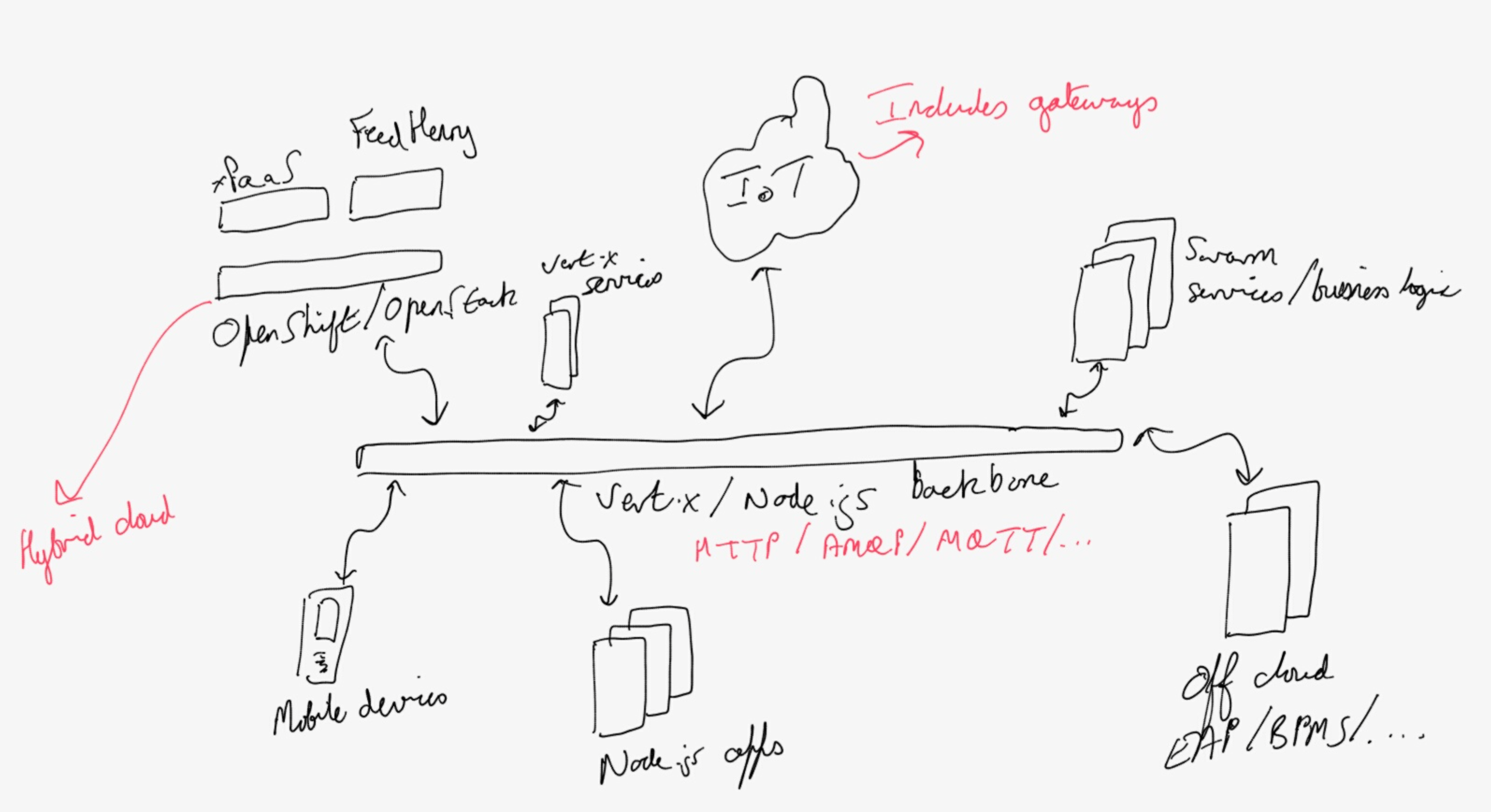
Below is a hand-drawn outline of where I see these things going. Apologies that it's not a nice block diagram and for my handwriting 

Screen Shot 2015-10-27 at 15.49.17.png